

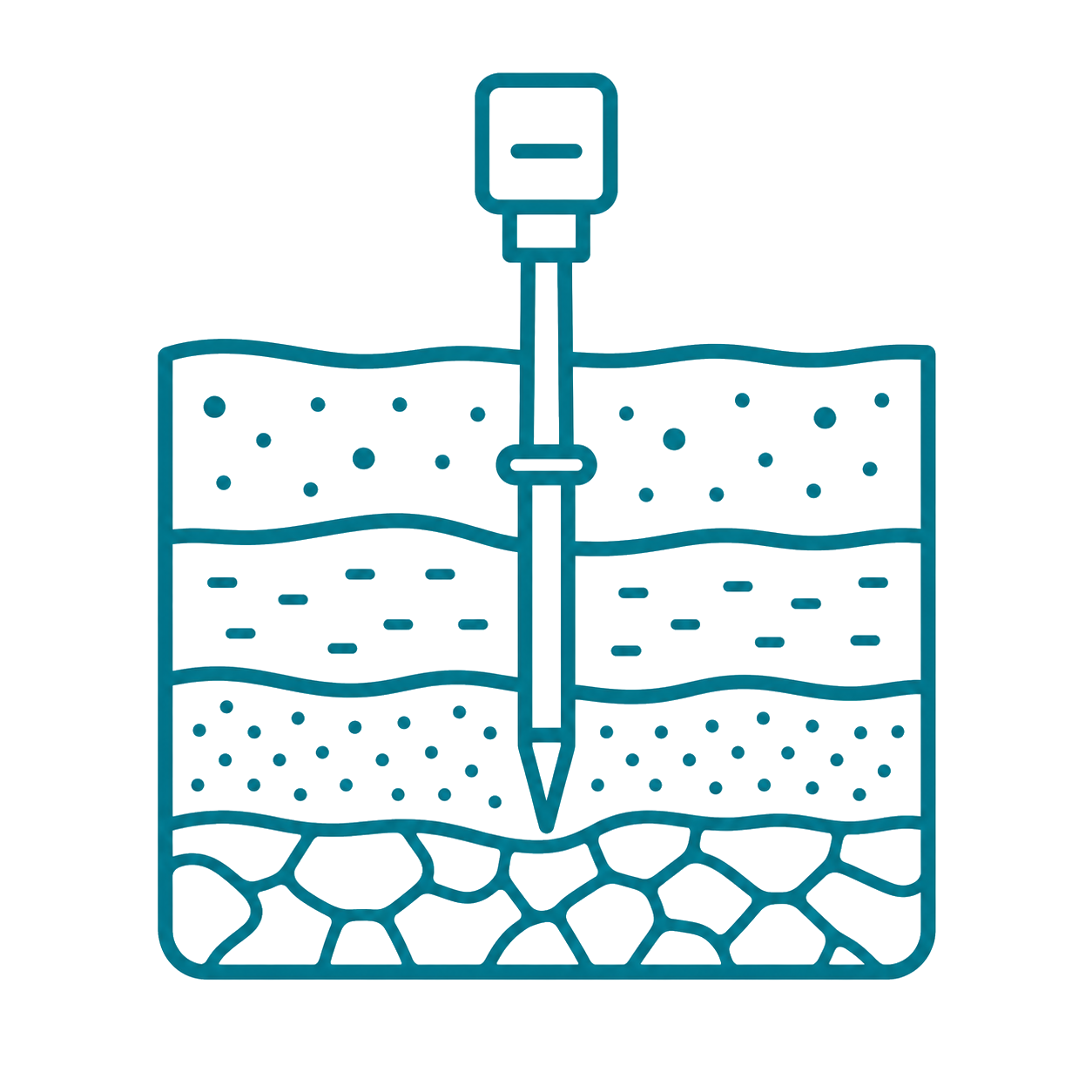
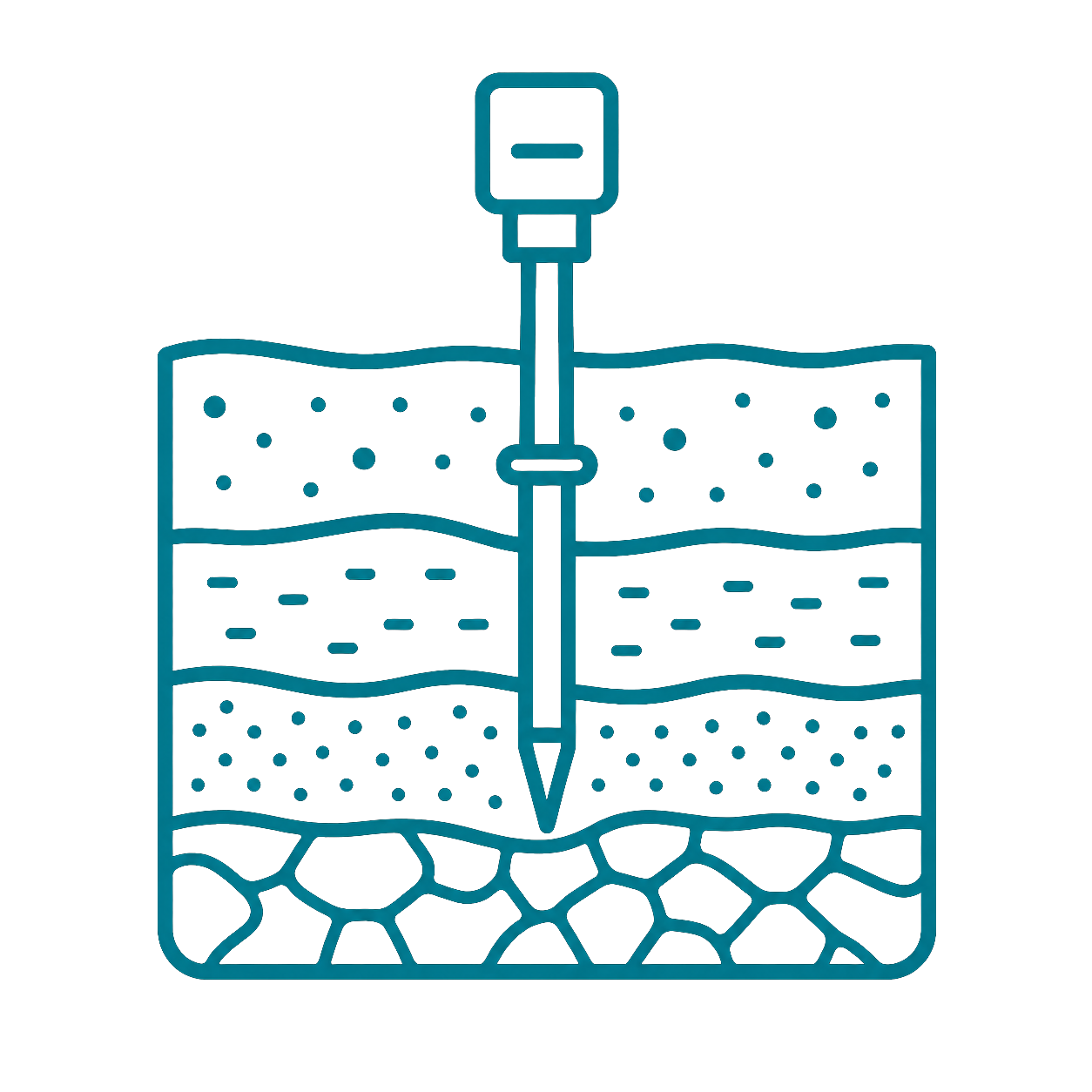
Pile Capacity Calculator (end bearing + skin friction)
Estimates the ultimate and allowable axial capacity of a single straight-shaft pile as the sum of end bearing and skin (shaft) friction. Geotechnical engineers use it for preliminary pile sizing from unit base and shaft resistances.
Enter Values
Minimum 0
Minimum 0
Minimum 0
Before you rely on this: First-pass guide only. Verify safety-critical or regulated work against the relevant standards, your project requirements and a qualified professional.
How to use this calculator
- Enter the pile diameter D (m) and embedded length L (m).
- Enter the unit end-bearing resistance qb (kPa) and the average unit shaft friction fs (kPa).
- Set a factor of safety (default 2.5) and read Qb, Qs, ultimate Qu and allowable Qa.
How it works
The static capacity of a pile is Qu = Qb + Qs. End bearing is Qb = qb·Ab, where the base area Ab = π·D²/4. Shaft resistance is Qs = fs·As, where the shaft (side) area As = π·D·L. The unit resistances qb and fs come from soil parameters — for example qb = Nq·σ′v (sand) or Nc·cu (clay), and fs = α·cu (total-stress) or β·σ′v (effective-stress).
The allowable working load divides the ultimate capacity by a single global factor of safety, commonly 2.5–3.0, which covers uncertainty in both the base and shaft terms and provides a settlement margin. This tool models one straight-shaft pile only.
Worked example
600 mm bored pile, 15 m embedment. For D = 0.6 m, L = 15 m, qb = 3000 kPa, fs = 50 kPa: Ab = π×0.6²/4 = 0.2827 m², As = π×0.6×15 = 28.27 m². Qb = 3000×0.2827 = 848 kN, Qs = 50×28.27 = 1414 kN. Qu = 848 + 1414 = 2262 kN; with FoS 2.5, Qa ≈ 905 kN.
Common mistakes
- Using the base area for the shaft term — the shaft uses the perimeter area π·D·L, not the cross-section.
- Ignoring negative skin friction (downdrag) in settling or filled ground, which reduces net capacity rather than adding to it.
- Applying a single-pile capacity to a closely spaced group without a group-efficiency reduction.
Frequently asked questions
What is the difference between end bearing and skin friction?
End bearing is the load carried at the pile base (Qb = qb·Ab). Skin (shaft) friction is the load transferred along the pile shaft to the surrounding soil (Qs = fs·As). Their sum is the ultimate capacity.
Where do qb and fs come from?
They are unit resistances derived from soil tests: end bearing qb = Nq·σ′v (sand) or 9·cu (clay); shaft friction fs = α·cu (alpha method) or β·σ′v (beta method). This tool takes the finished qb and fs values directly.
What factor of safety is appropriate?
A global factor of safety of 2.5–3.0 on ultimate axial capacity is common for piles designed from soil parameters; static or dynamic load tests can justify a lower value.
Does this cover pile groups?
No. It gives single-pile capacity only. For groups you must apply a group-efficiency factor and check block failure and group settlement separately.
Is negative skin friction included?
No. Downdrag from consolidating soil or fill acts downward and reduces net capacity; it must be assessed separately and is not part of this estimate.
Related tools
- Bearing Capacity (Terzaghi) Calculator
- Pad Footing Bearing Pressure Calculator
- SPT N-Value to Relative Density Calculator
- Soil Specific Gravity Calculator
- Consolidation Coefficient (Cv) Calculator
- CPT Friction Ratio Soil Classification Tool
Explore more in Geology, Geotechnical & Ground Engineering.
Cite this tool
Zerdly. (2026). Pile Capacity Calculator (end bearing + skin friction). Retrieved from https://www.zerdly.com/tools/pile-capacity-calculator-end-bearing-skin-friction/
Tip: Enter any known values to calculate the remaining results.
Designed to run locally in your browser. Tool inputs are not intentionally stored by Zerdly unless stated otherwise.